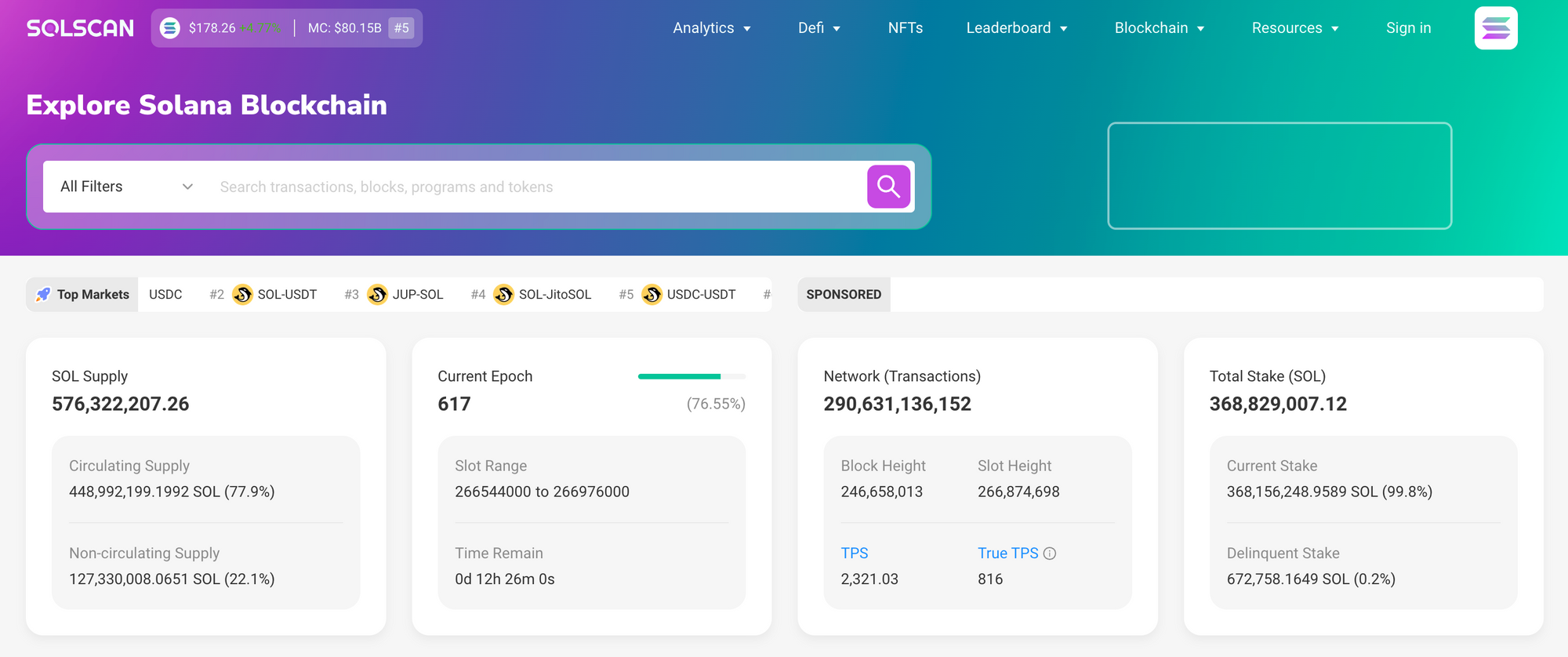
Whoa! This whole Solana-explorer world moves fast. Seriously? It does. My first impression was: flashy dashboards, lots of colors, and somethin’ that feels built for traders and devs at once. But then I dug deeper and that first look started to peel back — there are little traps, and some genuinely clever tools hidden in plain sight.
Here’s the thing. Solscan is more than a block-and-transaction viewer. It’s a token tracker, a program inspector, and an analytics suite rolled into one. Short version: if you need to verify a mint, watch token flows, or audit transactions for suspicious activity, you can do most of that here. Hmm… that sounds simple, but the ways you approach it matter. Initially I thought it’d be just another explorer, but then realized the depth of token metadata and historical token holder views make it genuinely useful for on-chain sleuthing.
Start with the search bar. It’s fast. It’s forgiving of partial inputs. Search a wallet address, a transaction signature, a token mint, or a program ID. A quick tip: paste the token mint into the search and switch to the “Token” view to see holders, transfers, decimals, and the token’s on-chain metadata. That’s where you often spot large token holders or unexpected drains. On one hand the UI makes it easy to trace flows, though actually interpreting those flows takes some care—wallet labels are community-driven and not always accurate.
Why token tracking matters (and how Solscan helps)
Token tracking is basically accountability. When a new token launches, you want to know who holds the supply. Is a dev wallet holding most of it? Are tokens locked? Solscan exposes holder distributions and transfer histories so you can form a hypothesis fast. My instinct said to check the top 10 holders first. That often reveals whether a rug is likely. Actually, wait—let me rephrase that: top holders are a signal, not proof. You need to cross-check token locks, vesting schedules, and related program accounts.
One thing bugs me about many explorers: they show data, but not the story. Solscan helps by letting you follow a token’s lineage — mint creation, initial distribution, and notable swaps. Check the “Transfers” tab to see big jumps. If you spot a 0.0.0 kind of swap or mass transfers to new wallets, raise an eyebrow. Something felt off about a token I audited last month — multiple tiny transfers preceded a whale move. That pattern is common in coordinated dumps.
For devs and more technical folks, the Program view is gold. It lists CPI calls, invoked program IDs, logs, and instruction breakdowns. If you’re trying to debug a failing transaction or understand a custom program’s state changes, this view saves time. On the other hand, if you’re not comfortable reading logs, it can be noisy. Still — seeing raw logs has helped many teams catch bugs that were invisible in higher-level SDKs.
Check liquidity pools and DEX interactions too. Transfers to common pool accounts often indicate market-making or listing events. And yes, NFT transfers have their own quirks — metadata is split between on-chain entries and off-chain JSON, so sometimes the explorer shows missing images while the token is perfectly valid.
FAQ
How reliable are Solscan’s wallet labels?
They’re community-sourced and heuristically assigned. Useful as hints. Not gospel. If you see “Exchange” on a label, verify by checking subsequent on-chain behavior. Sometimes labels lag behind reality or are misapplied. I’m biased, but I always cross-check with tx history.
Can Solscan show token locks or vesting?
Sort of. If locks are implemented via known program accounts you can spot them by inspecting program-owned accounts and transfer patterns. However, custom vesting schemes require manual inspection of program state. On one hand some projects publish vesting contracts publicly; on the other, private or ad-hoc methods need deeper analysis.
Where do I start if a token looks suspicious?
Three quick checks: 1) Look at top holders and note any centralized control. 2) Trace recent large transfers — where did funds go? 3) Inspect the mint creation tx to find the authority and initial distribution. If the trail goes cold, search program interactions for clues. Sometimes you find a bridge or swap path that explains odd movements.
Okay, so check this out—if you want the official source or to bookmark a reliable version of Solscan, click here. That link points to a stable landing that’s handy when you’re juggling multiple explorers and want to keep your tabs tidy. (oh, and by the way…) It’s good to have one canonical reference.
Tools and shortcuts I use often: keyboard search focus (saves time), copying a token mint and opening it in a second tab to compare holder snapshots, and using the transaction signature link to share findings with a team. Little things add up. Double-check decimals and supply numbers — a lot of confusion comes from misreading decimals, especially with tokens designed to mimic major ones.
On the more technical side: Solscan’s API can be integrated into dashboards for ongoing monitoring. That’s useful for projects that want alerting on unexpected large transfers. Initially I thought you’d need heavy dev work to get alerts, but with the API and simple webhooks it’s pretty approachable. There’s a setup cost, though. And sometimes endpoints change — so maintain your tooling and don’t assume forever stability.
Some closing honesty: I’m not 100% sure every corner of Solscan is perfect. There are occasional display bugs, label mismatches, and the occasional delay in showing new blocks under network stress. But for everyday token sleuthing and developer inspection, it’s one of the best pragmatic tools in the Solana ecosystem. If you’re weighing explorers, try a few tasks across them and see which one matches your workflow. You’ll notice preferences quickly — and you’ll adapt your mental models accordingly.